CEX.IO Prime Custody
Institutional Crypto Custody for Your Business and Your Clients
CEX.IO Prime keeps your crypto under MPC custody across hot and cold storage. Every client and every business line gets its own segregated sub-account, and trades settle on the same account that holds the assets.

MPC
Quorum signing across hot and cold storage
500+
Assets across 60+ networks
FIX 4.4
Plus REST, WebSocket and Webhooks
What institutional crypto custody is
Institutional crypto custody is the safekeeping of the private keys that control a business’s digital assets. Whoever can sign a transaction controls the assets, so custody decides who moves funds and on whose authority. For a fund, a broker or a payment firm, that authority has to sit behind controls an auditor can check.
Why businesses need it
Three reasons put a fund, a broker or a payment firm behind institutional custody.
No single point of failure
One lost device or one compromised employee cannot move client funds when every signature needs a quorum.
Client assets stay apart
Segregation keeps each client's holdings identifiable, so your team reconciles and audits without untangling shared records.
A record for every movement
The audit trail shows who requested a transfer, who approved it and where the funds went.
Three ways a business holds crypto
Each model answers the same questions: who holds the keys, where trading happens and who reconciles.
Standalone custodian
The custodian holds the keys. You trade at a separate venue after a transfer, so your team reconciles across two providers.
Custody inside CEX.IO Prime
Prime holds the keys under your withdrawal rules. You trade on the same account, so one internal ledger carries the whole record.
In-house wallet stack
Your own team holds the keys, connects every trading venue itself and reconciles every movement on its own.
Institutional custody on CEX.IO Prime
Yes, CEX.IO Prime runs institutional custody. It is one of the six Prime products, and it sits under every Prime account next to liquidity, settlement and reporting.
Keys under MPC across hot and cold storage
Multi-party computation splits signing across independent key shares, and a quorum signs every transaction. One person or one device cannot move funds alone. Prime runs hot and cold storage behind the same account, so your team never builds or operates the custody stack.

A segregated holding for every sub-account
Each sub-account carries its own deposit addresses for every asset and network you use. Incoming crypto lands on the right sub-account automatically, so nobody on your team matches deposits by hand. Transfers between sub-accounts settle instantly and cost nothing.

Withdrawals under your own rules
A mandatory whitelist limits every withdrawal to addresses you register in advance. Your approval policy runs single, dual or threshold, and full audit logging records each request, each approval and each transfer.

How CEX.IO Prime institutional crypto custody works
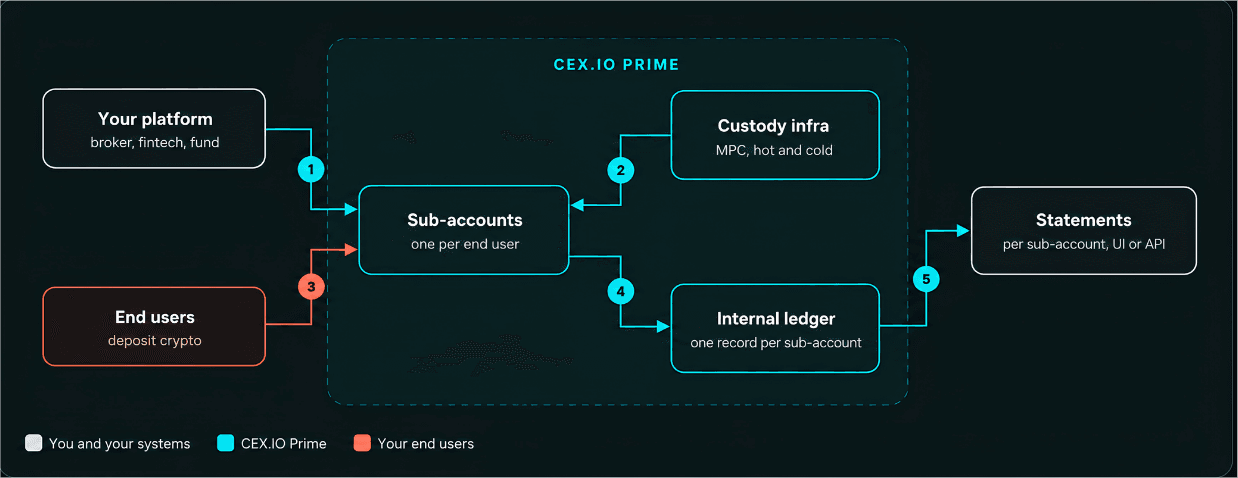
The model below follows one deposit from the moment you open a sub-account to the moment your team signs off a withdrawal. Your platform keeps the brand and the customer relationship, and Prime runs the custody underneath.
How it works
You create a sub-account for each end user or business line through the Prime API or the interface. Prime Custody issues that sub-account its own deposit addresses per asset and network, so incoming crypto reaches the right holding without manual matching.
After network confirmations, the internal ledger credits each deposit to the right sub-account. Holdings stay segregated per sub-account, and internal movements run instantly and free.
Your team reconciles and reports per sub-account from Prime statements. The mandatory whitelist and your approval workflow govern every withdrawal.
Example
A crypto savings app gives each user a sub-account with its own BTC and USDT addresses. Deposits land on the right sub-account automatically, and the app reconciles every user from Prime statements.
Why clients use it
- Custody-grade safekeeping under MPC across hot and cold storage, with no stack to build.
- Automatic attribution per end user through sub-account deposit addresses.
- Instant, free internal transfers and clean reporting per user.
- Governance through the mandatory whitelist and configurable approvals.
- One account for custody, liquidity, settlement and reporting.
Three custody models you can run on Prime
Clients hold their own treasury on Prime, and clients hold crypto for their own users on Prime. Sub-accounts carry the separation wherever a model needs it.
Custody for your end users
Create a sub-account per end user, each with its own deposit addresses and reporting. Your app keeps the brand, the interface and the customer relationship.
Example
A savings app issues every user dedicated BTC and USDT addresses and reconciles each user from Prime statements.
Managed accounts and mandates
Run each mandate or strategy as its own sub-account, execute per mandate against aggregated liquidity and report per mandate under one relationship.
Example
A fund manager runs three strategies as three sub-accounts and sends investors a monthly statement per strategy.
Settlement and reporting backbone
Every operation on Prime posts to one ledger with consistent identifiers. You pull account and sub-account statements through the interface or the API and feed your own accounting.
Example
A treasury team pulls a monthly statement per sub-account through the API straight into its ERP.
Why institutions choose CEX.IO Prime for custody
Custody on Prime runs on the same account as your execution, settlement and reporting. Six things follow from that.
Custody for your own clients
A sub-account per end user, with its own deposit addresses, built into the Prime account.
Automatic deposit attribution
The internal ledger credits each deposit to the right sub-account after network confirmations.
Free internal transfers
Moves between sub-accounts settle instantly and cost nothing.
One ledger
Custody, trading, settlement and reporting post to one internal ledger with consistent identifiers.
Controls you set
Mandatory whitelist, single, dual or threshold approvals, roles and limits per sub-account.
One integration
Web portal, REST, WebSocket, FIX 4.4, Webhooks and a sandbox, with a dedicated account manager.
Let's talk to us about custody
Tell us what you hold, who you hold it for and how your team approves a withdrawal. We scope the account structure and the controls around your operation.

FAQ
What is institutional crypto custody?
Institutional crypto custody is the safekeeping of the private keys that control a business’s digital assets. Whoever can sign a transaction controls the assets, so custody sets who can move funds and on whose authority. On CEX.IO Prime, MPC custody holds the keys, and a whitelist and an approval workflow govern every withdrawal.
How does institutional crypto custody work on CEX.IO Prime?
You open a sub-account through the Prime API or interface, and Prime issues it deposit addresses for each asset and network. After network confirmations, the internal ledger credits each deposit to the right sub-account. You reconcile per sub-account, and every withdrawal passes the whitelist and your approval workflow.
Can I hold crypto on behalf of my own customers?
Yes. You create a sub-account for each end user, and each one receives its own deposit addresses. User deposits land in the right sub-account automatically, and you reconcile per user from Prime statements. A savings app, broker or wallet keeps its own brand and its own customer relationship.
Who approves a withdrawal?
Your team decides. A mandatory whitelist limits withdrawals to addresses you register in advance. Approval policy runs single, dual or threshold, and full audit logging records each request, each approval and each transfer.
What is the difference between hot and cold storage?
Hot storage keeps signing online, so funds move fast. Cold storage keeps key material offline, away from network threats. CEX.IO Prime runs custody across both under MPC, so one account covers daily movement and longer holding.
Which assets and networks can I hold?
Prime covers 500+ assets across 60+ networks, including BTC, ETH and stablecoins. CEX.IO sets assets, networks, limits and controls per client at onboarding and adds coverage as client demand grows.
Does CEX.IO Prime offer institutional crypto custody?
Yes. Institutional custody is one of the six CEX.IO Prime products. It holds crypto under MPC custody across hot and cold storage, keeps holdings segregated per sub-account and runs on the same account as liquidity, settlement and reporting.
How does CEX.IO Prime secure private keys?
Prime uses multi-party computation. MPC splits signing across independent key shares and a quorum signs every transaction, so one person or one device cannot move funds alone. Prime runs hot and cold storage behind the same account, and your team never builds or operates that stack.
How do you keep client holdings separate?
Every sub-account carries its own holdings and its own deposit addresses, and the internal ledger attributes each movement to one sub-account. You can separate end clients, mandates, business lines and operational funds, and each one reports on its own.
Can I trade crypto that sits in custody?
Yes. Custody, Prime Liquidity and settlement share one account and one internal ledger. An order executes against holdings you already keep, and the result settles back into the same account. Internal transfers between sub-accounts run instantly and cost nothing.
How do I connect custody to my own systems?
Through the Prime web portal or the API: REST, WebSocket, FIX 4.4 and Webhooks. Your team tests in a sandbox first, and statements per account and per sub-account come through the interface or the API.
How do I open a custody account on CEX.IO Prime?
Three steps: agreement, onboarding and platform access. We agree scope, products and limits with you, run a single onboarding with a dedicated account manager, then configure your accounts, sub-accounts and approval policy and issue production keys.